
Content Menu
● Introduction: Why This Comparison Matters
● Hibachi vs Teppanyaki: Core Technical Differences
>> Cooking method and equipment
● Mobile Hibachi vs At‑Home Teppanyaki for Events
>> Experience and entertainment
● Comparison Table: Which Fits Your Party Best?
● Logistics: Setup, Space, and Safety at Home
● Pricing, Value, and Guest Count (Expert Insight)
● 2026 Catering Trends: Why Mobile Hibachi Is Surging
● How a Professional Mobile Hibachi Service Operates (Step‑by‑Step)
● Personal & Expert View: When to Choose Each Option
● UX‑Focused Tips for Hosting a Smooth Hibachi or Teppanyaki Party
● Where Hibachi Sake Sake Fits In (and Why It Matters)
● CTA: Ready to Turn Your Backyard Into a Private Hibachi Show?
● FAQs
Introduction: Why This Comparison Matters
As a private mobile hibachi chef team serving Florida, Georgia, South Carolina, and North Carolina, I’m often asked: “Is this hibachi… or teppanyaki?” and, more importantly, “Which one is better for my backyard party or corporate event?” From an industry insider’s perspective, the real difference is not just the grill—it’s the show, the flavor profile, the logistics, and how smoothly everything works at your home or venue. [kaijinbuffet]
This guide breaks down mobile hibachi vs at‑home teppanyaki in plain language, so you can choose the experience that delivers maximum fun, flavor, and value for your next celebration.
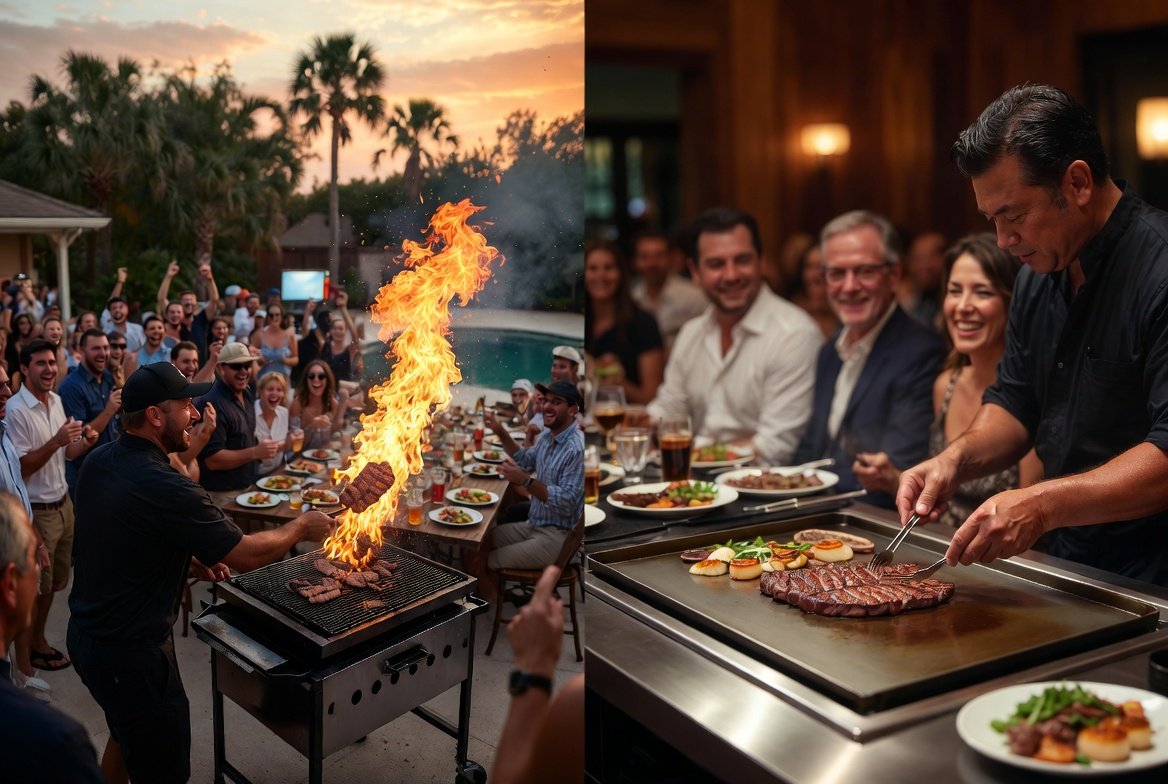
What Is Mobile Hibachi?
In modern catering, mobile hibachi usually means a chef bringing a compact grill setup, ingredients, sauces, and entertainment directly to your home, backyard, or event space. While “hibachi” historically referred to a small charcoal heating vessel, today’s mobile hibachi services often use portable gas-powered flat grills designed for safety and consistency at private events. [natlawreview]
Key traits of mobile hibachi at events
– Chef travels to your location with equipment and ingredients
– High‑energy show: fire tricks, jokes, egg tosses, sake or “sake-style” fun
– Menu built around classic hibachi steak, chicken, shrimp, veggies, fried rice
– Works well in backyards, driveways, patios, and some indoor spaces with proper ventilation [hibachiomakase]
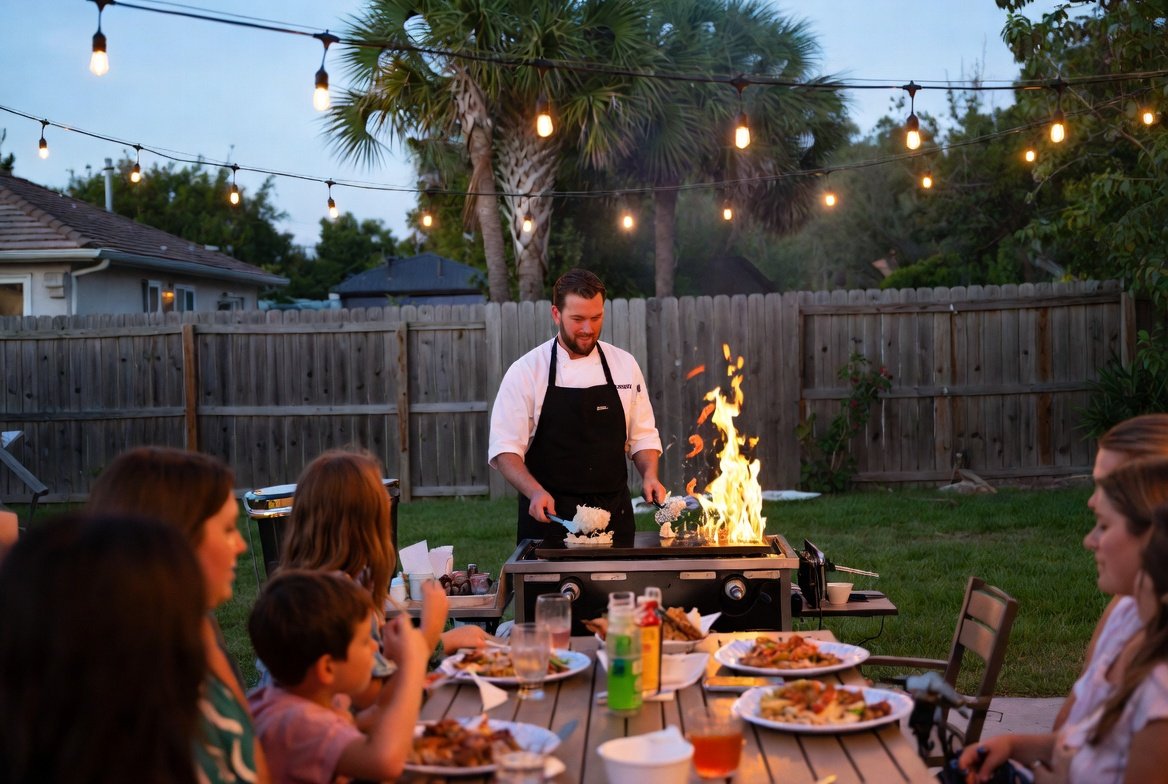
What Is At‑Home Teppanyaki?
Teppanyaki literally means “grilling on an iron plate,” and in restaurant settings it uses a large, flat, stainless or iron griddle built into the table, heated by gas or electricity. At‑home teppanyaki experiences aim to replicate that sleek, chef‑at‑the‑center performance in private settings, often with a bigger emphasis on precision cooking and plated presentation. [hibachiomakase]
Key traits of at‑home teppanyaki
– Emphasis on a smooth, restaurant‑style flow and precise cooking temperatures
– Large, flat iron‑plate grill, often wider than typical backyard grills
– Focus on high‑quality cuts (steak, scallops, lobster, premium seafood) and refined sauces [kobesteakhouse]
– Chef’s performance is still entertaining, but usually leans more into culinary technique than party games [kaijinbuffet]
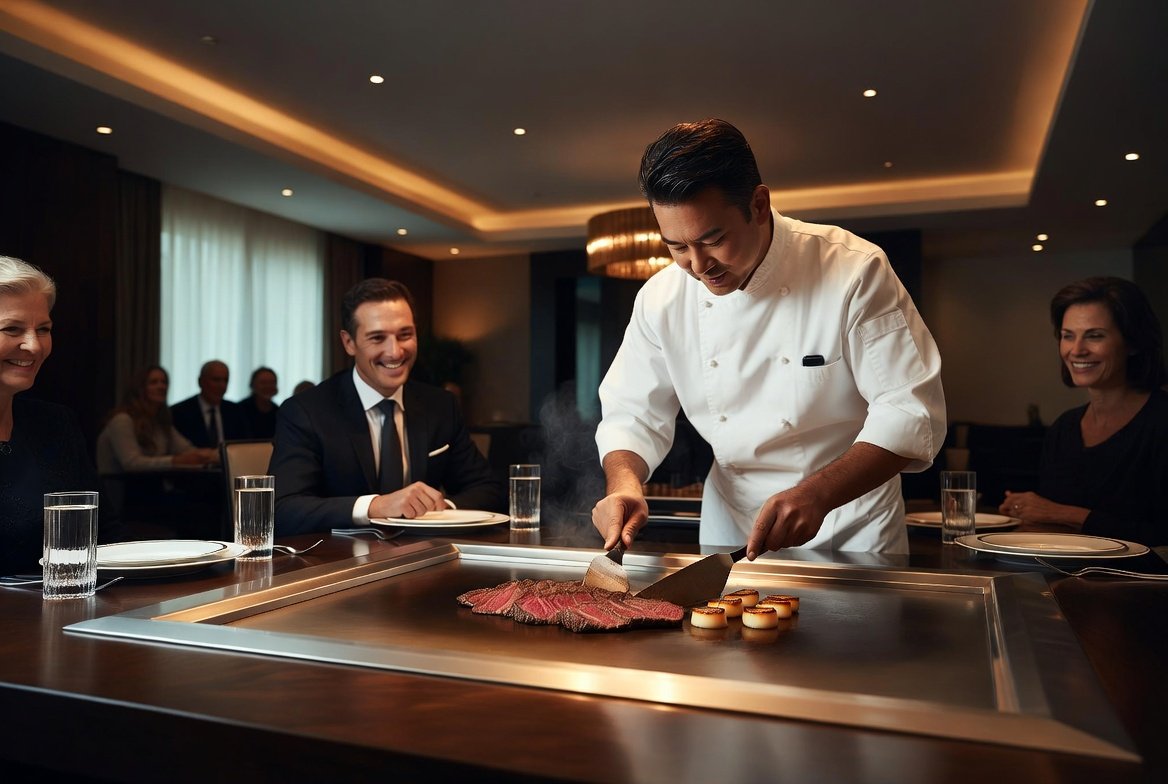
Hibachi vs Teppanyaki: Core Technical Differences
From an expert standpoint, separating terminology from modern practice is crucial. Many “hibachi” restaurants in the US are actually cooking teppanyaki‑style on flat griddles. [hibachiomakase]
Cooking method and equipment
– Hibachi (traditional):
– Small grill with a grate
– Charcoal or wood as fuel
– Direct open flame, smoky flavor [kobesteakhouse]
– Teppanyaki (modern):
– Large, flat iron griddle
– Gas or electric heating
– Even heat distribution, perfect for stir‑frying and searing [hibachiomakase]
Flavor and texture profile
– Hibachi‑style: More smoke, slightly rustic grill marks, simple seasoning to highlight natural flavors. [kobesteakhouse]
– Teppanyaki‑style: Clean sear, controlled browning, sauces and butter used to build layered flavor on the griddle. [hibachiomakase]
Mobile Hibachi vs At‑Home Teppanyaki for Events
From a mobile catering lens, the real comparison is about experience design: how food, show, timing, and logistics fit your event.
Experience and entertainment
– Mobile hibachi
– High‑energy, playful, lots of interaction
– Perfect for birthdays, family reunions, graduations and casual corporate outings
– Guests expect onion volcanoes, egg tricks, sake bottles, and plenty of laughter [natlawreview]
– At‑home teppanyaki
– Slightly more refined, closer to a luxury chef’s table
– Ideal for intimate dinners, upscale corporate entertaining, or small luxury celebrations
– Focus on knife skills, precise searing, and plated presentation rather than big “party tricks” [kobesteakhouse]
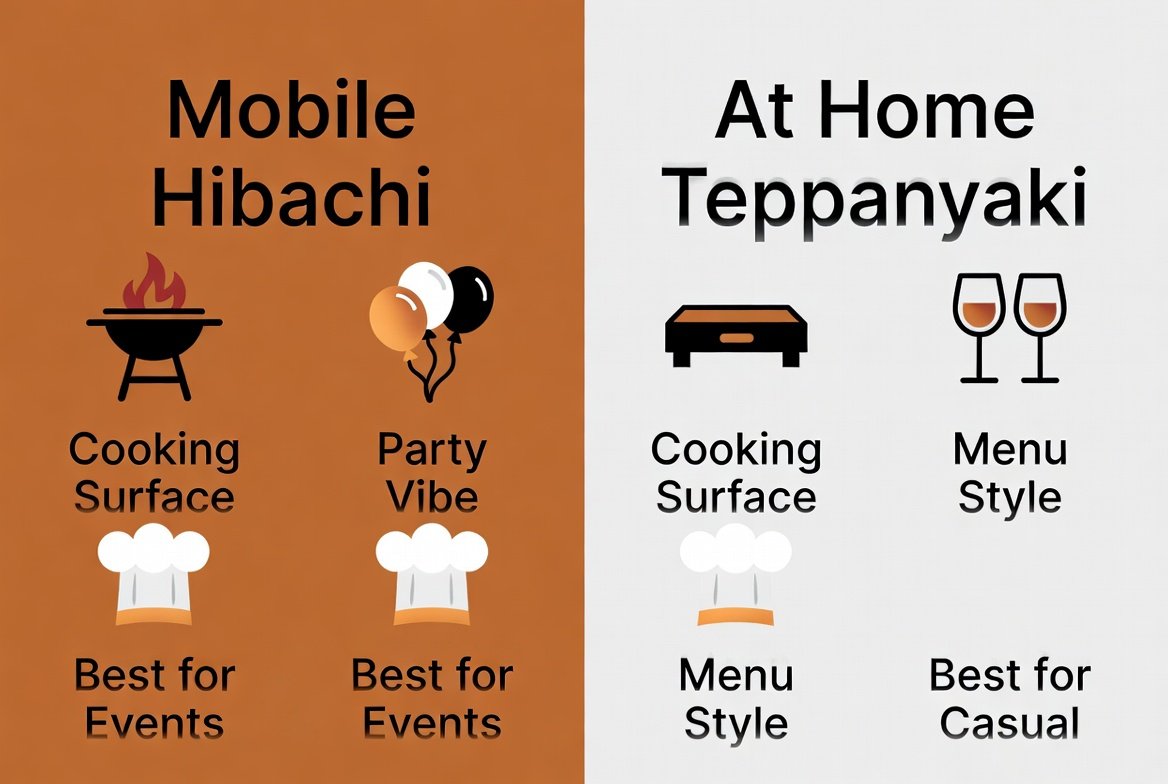
Comparison Table: Which Fits Your Party Best?
| Aspect | Mobile Hibachi Experience | At‑Home Teppanyaki Experience |
|---|---|---|
| Cooking surface | Portable grill or flat‑top, event‑ready setup kaijinbuffet | Large, flat iron griddle, restaurant‑style hibachiomakase |
| Fuel & heat | Usually gas, sometimes electric for safety kaijinbuffet | Gas or electric, very even heating hibachiomakase |
| Party vibe | Loud, playful, social, family‑friendly kaijinbuffet | Refined, culinary‑focused, intimate hibachiomakase |
| Typical menu | Steak, chicken, shrimp, veggies, fried rice, noodles kaijinbuffet | Premium steak, scallops, lobster, composed courses hibachiomakase |
| Best for | Birthdays, backyard parties, graduations, casual corporate events natlawreview | Luxury private dinners, executive events, foodie groups hibachiomakase |
| Space needs | Flexible in backyards, patios, driveways; easy to scale for larger groups natlawreview | Works best where there’s flat space and stable power supply hibachiomakase |
Logistics: Setup, Space, and Safety at Home
From a mobile‑chef point of view, logistics make or break the experience more than the grill name.
Space and layout
– Clear, flat space for the grill and a safe perimeter
– Enough room for guest seating facing the chef for maximum engagement
– Consider wind direction and proximity to walls, trees, and decorations for outdoor setups [natlawreview]
Safety considerations
– Stable surface for grills
– Distance from flammable materials
– Access to ventilation (for covered patios or indoor spaces)
– Following local codes and HOA rules where applicable [natlawreview]
Experienced mobile teams in the Southeast—especially those frequently serving Florida and coastal states—design their setups for variable weather, tight driveways, and diverse backyard layouts. [hibachisakeke]
Pricing, Value, and Guest Count (Expert Insight)
Industry‑wide, mobile hibachi and at‑home teppanyaki pricing generally follow a per‑person model with a minimum spend. For example, some mobile hibachi providers in the Southeast start around 50 USD per person with a minimum of approximately 500 USD, depending on menu and location. [hibachifamily]
What typically drives cost
1. Guest count and table setup
2. Menu tier (standard vs premium meats and seafood)
3. Travel distance and multi‑state coverage
4. Add‑ons such as extra chefs, extended time, or sake‑focused experiences [hibachifamily]
In practice, mobile hibachi is often the most cost‑effective way to create a “Japanese steakhouse show” feel for medium and large groups, while at‑home teppanyaki tends to sit at a slightly higher price point because it usually involves premium ingredients and a more curated, multi‑course structure. [hibachifamily]
2026 Catering Trends: Why Mobile Hibachi Is Surging
Recent catering trend reports show a strong move toward interactive, chef‑led experiences and outdoor dining. As regulations, weather patterns, and guest expectations evolve, hosts are looking for options that feel both safe and unforgettable. [tgiscatering]
Key 2026 trends favoring mobile hibachi and teppanyaki
– Guests want experiences, not just food—live cooking, flames, and storytelling are winning features [tgiscatering]
– Outdoor and backyard events remain popular in warm‑weather states like Florida, Georgia, and the Carolinas [tgiscatering]
– Hyper‑personalized menus and themed events (e.g., sake‑forward celebrations, surf‑and‑turf nights) are in high demand [tgiscatering]
Mobile hibachi sits at the sweet spot of these trends: it turns your driveway or backyard into a private Japanese‑style steakhouse with a built‑in show.
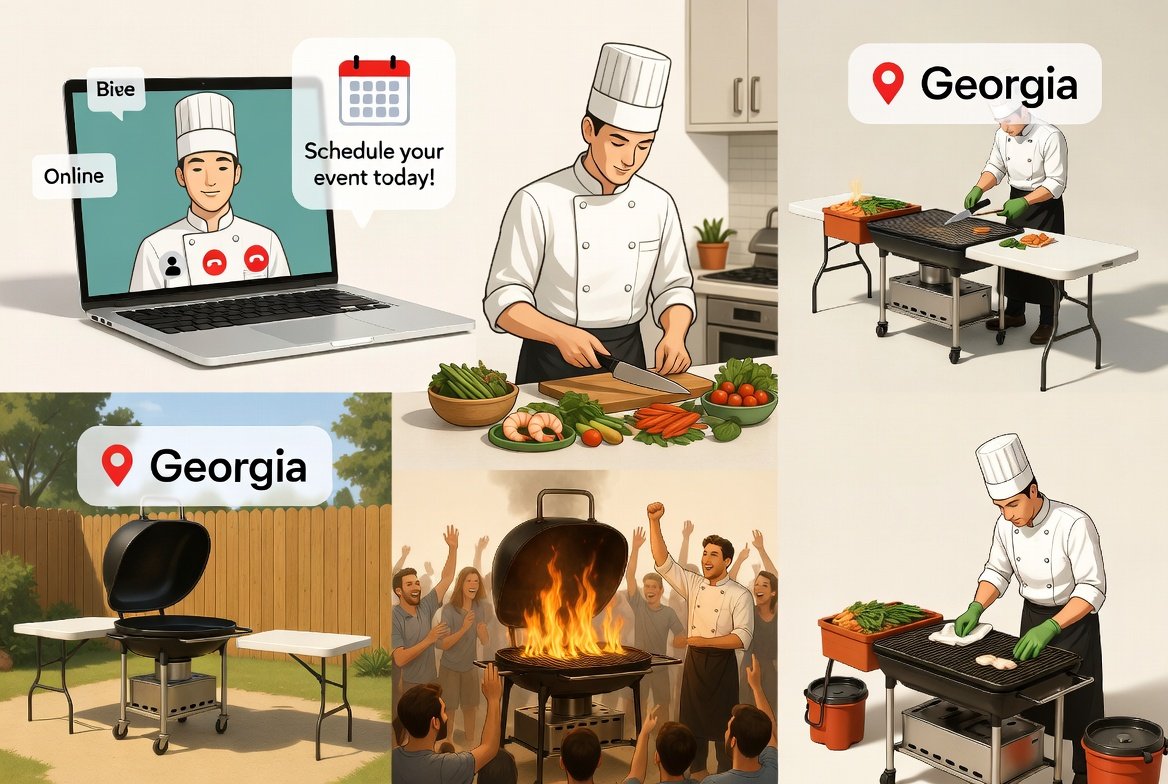
How a Professional Mobile Hibachi Service Operates (Step‑by‑Step)
Drawing on industry best practices used by leading mobile teppanyaki brands, the flow of a professional mobile hibachi experience looks like this: [hibachiomakase]
1. Pre‑booking consultation
– Clarify event type, guest count, location, and date
– Discuss menu style (classic hibachi, surf & turf, kid‑friendly options, etc.)
2. Menu and experience design
– Choose proteins, sides, and any dietary accommodations
– Align on entertainment tone: family‑friendly, corporate, or high‑energy party
3. On‑site setup
– Chef arrives early with grill, utensils, and ingredients
– Layout is adjusted to your yard, patio, or indoor area for best guest visibility
4. Showtime and service
– Guests are seated facing the grill
– Chef performs, cooks, and plates in real time for each guest
5. Cleanup and breakdown
– Mobile team removes equipment and disposables, leaving the space tidy
This workflow is designed to minimize friction for hosts: no grocery runs, no cooking stress, and no heavy cleanup afterward.
Personal & Expert View: When to Choose Each Option
As someone who lives in this category every day, here’s the practical decision rule I share with hosts:
– Choose mobile hibachi when you want:
– A high‑energy centerpiece for birthdays, graduations, and large family parties
– Something that keeps kids, teens, and adults equally engaged
– A predictable, scalable solution for 10–40+ guests in one or multiple seating waves
– Choose at‑home teppanyaki when you want:
– A more intimate, chef‑driven culinary experience
– A luxury feel with premium cuts and wine‑ or sake‑friendly courses
– A quieter evening where conversation and plating are as important as the tricks
In warmer, event‑heavy states like Florida, Georgia, South Carolina, and North Carolina, a hybrid approach is rising: mobile chefs equipped with teppanyaki‑style flat grills, delivering a hibachi‑level show with teppanyaki‑level precision. [hibachisakeke]
UX‑Focused Tips for Hosting a Smooth Hibachi or Teppanyaki Party
To maximize the experience for your guests:
– Clarify the vibe early in invitations: fun hibachi party vs intimate teppanyaki dinner
– Group guests by energy level if you have multiple seatings—kids and high‑energy friends together, more relaxed diners in another wave
– Plan music and lighting around the show: lower volume when the chef is interacting, warm lighting for photos
– Communicate dietary needs before booking: gluten‑free sauces, vegetarian options, shellfish allergies
Where Hibachi Sake Sake Fits In (and Why It Matters)
For hosts across Florida, Georgia, South Carolina, and North Carolina, a brand like Hibachi Sake Sake is built specifically for:
– Backyard hibachi parties
– Driveway setups in residential neighborhoods
– Private, chef‑centered experiences at home or rental properties
– Multi‑state coverage for people who gather family or teams from different cities [hibachisakeke]
By focusing on mobile, on‑site execution, a specialist brand can fine‑tune menus, equipment, and service flow for local weather, housing layouts, and regional tastes—something generic caterers struggle to match. [hibachiomakase]
CTA: Ready to Turn Your Backyard Into a Private Hibachi Show?
If you’re planning a birthday, family reunion, holiday celebration, graduation party, corporate event, or luxury private dinner in Florida, Georgia, South Carolina, or North Carolina, this is the moment to lock in your date.
Choose the experience that fits your vision—mobile hibachi for big, unforgettable fun or teppanyaki‑style precision for an elevated chef’s table—and let a professional team handle the rest.
FAQs
1. Is mobile hibachi safe in a typical backyard?
Yes, when handled by trained chefs using gas or electric grills designed for events, mobile hibachi is engineered for safety with controlled flames and clear spacing from flammable materials. [kaijinbuffet]
2. How much space do I need for mobile hibachi or at‑home teppanyaki?
Most events work with a flat area large enough for the grill and a table of guests; patios, driveways, and open backyards are usually sufficient if the chef has a clear, unobstructed work zone. [natlawreview]
3. Can mobile hibachi handle different dietary restrictions?
Experienced mobile chefs regularly accommodate vegetarian guests, gluten‑sensitive diners, and shellfish allergies by planning custom sauces, separate cooking zones, or alternate proteins. [kaijinbuffet]
4. Which experience is better for kids and mixed‑age groups?
Mobile hibachi tends to be the most engaging for kids, teens, and adults together because of its interactive show, jokes, and visual flames, while still delivering full meals. [kaijinbuffet]
5. When should I book for peak seasons in Florida and neighboring states?
Spring and early summer weekends fill quickly for outdoor hibachi and teppanyaki events, so it’s wise to reserve several weeks—or even months—ahead, especially for graduations and holidays. [tgiscatering]
References
1. Kaijin Buffet – “Hibachi vs Teppanyaki: What’s the Real Difference?” (2026). [https://kaijinbuffet.com/hibachi-vs-teppanyaki-whats-the-real-difference] [kaijinbuffet]
2. Hibachi Omakase – Service coverage and hibachi at home overview. [https://www.hibachiomakase.com] [hibachiomakase]
3. Hibachi Omakase – “What is Hibachi? Hibachi vs Teppanyaki: What’s the Difference?” (2024). [https://www.hibachiomakase.com/hibachi-vs-teppanyaki-whats-the-difference] [hibachiomakase]
4. Kobe Steakhouse – “Teppanyaki vs Hibachi: What’s the Difference?” (2024). [https://kobesteakhouse.com/teppanyaki-vs-hibachi-whats-the-difference] [kobesteakhouse]
5. The National Law Review – “Outdoor Dining Demand Rises, Hibachi Catering Gains Popularity for Spring Parties.” [https://natlawreview.com/press-releases/outdoor-dining-demand-rises-hibachi-catering-gains-popularity-spring-parties] [natlawreview]
6. TGIS Catering – “Top Catering Trends for 2026: Fresh Ideas to Make Your Event Unforgettable.” [https://www.tgiscatering.com/tgis-catering-blogs/nbsptop-catering-trends-for-2026-fresh-ideas-to-make-your-event-unforgettable] [tgiscatering]
7. Hibachi Sake Sake – Florida hibachi backyard event page. [https://hibachisakeke.com/pages/florida-hibachi-backyard-event] [hibachisakeke]
8. Hibachi Family – Mobile Hibachi in South Carolina – pricing details. [https://hibachifamily.com/south-carolina] [hibachifamily]
Hot Tags: Mobile Hibachi Catering, At Home Teppanyaki, Backyard Hibachi Party, Private Hibachi Chef, Corporate Hibachi Events, Outdoor Teppanyaki Catering, Florida Hibachi Service, Georgia Teppanyaki Catering, Carolina Hibachi Parties, Luxury Private Dining